This post can also be read on substack, and you can subscribe there if you want email updates about new, similar writing
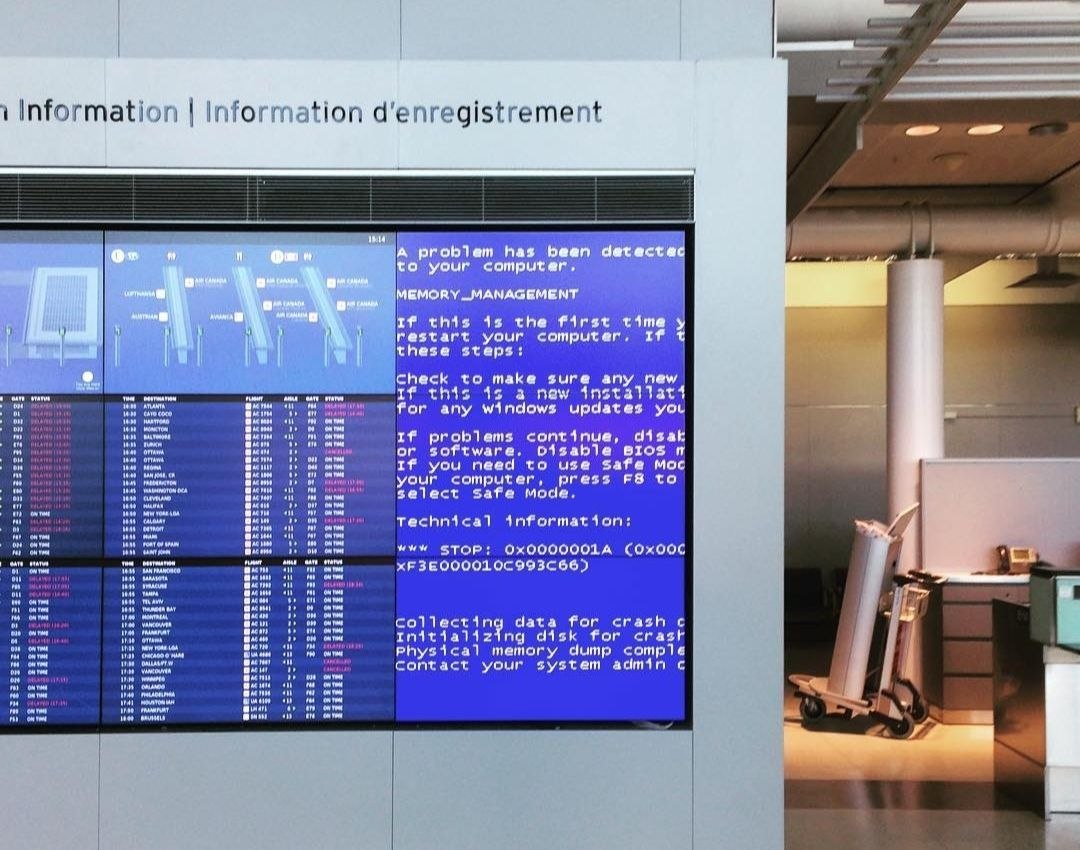
*Someone should call a software developer to fix this*
“I haven’t opened an IDE in months” or so goes the confession passed around the group chat, by men who take pride (or did until very recently) in their knowledge of vim shortcuts, github repo of dotfiles, and rare tiling desktop manager. Claude Code has eaten the software industry that just recently ate the world.
I learned to write software late in life, comparatively speaking. I was 24, it was the 2010s, we were fresh out of Gamergate and “woman in tech” discourse, and I’d been stepping sideways into more and more technical work since finishing undergrad. I’d studied painting — figurative oil painting, even — maybe the most offline thing you can specialize in, but I was hungry to do something else. To change my circumstances, physically, financially, any and every way, actually.
And it also seemed to me, as my work over the last few years had brought me closer and closer to them, that these men, these “software developers” didn’t actually have any special magic power I didn’t have or couldn’t access. They couldn’t find a derivative in their head. They couldn’t even do high school math. At work one day, before I myself joined their ranks, I overheard one software developer asking the other, “Bro, how do you find the center of a triangle again?” Neither of them knew.
If you have to simmer for a long time first, then simmer, but when you boil over, boil completely. Try to be like a metal rod sticking up in the storm, and make yourself appealing to the lightning strike. Because when you’re setting out to do something very hard, it will help if you resemble an act of god. I say this because the process of becoming a software developer the way I did – to the point of having a full time engineering job, to managing a software team, to hiring and vetting the technical work of others, all without formal training of any kind – was hard. It’s actually one of the hardest things I’ve done, and it took years. And I did much of it while working other jobs, nervously turning up at the meetup, an art school kid taking the streetcar to the business district, literally the only girl in the room. I had to put it on like a costume – swag T-shirt from a conference, baggy pants, never showing knees or shoulders, no make up, low pony – until I forgot it was a costume. I only stopped wearing it years later, when I felt I had nothing left to prove. When people ask me for advice, how to do something similar, I tell them I recommend being motivated by spitefulness and the desire to prove wrong those who’ve underestimated you.
But besides what I have in common with a Disney villain, one of the reasons it worked for me – not the only one but the one this essay is about – is that I literally became a software developer. This is something different than becoming a person who knows how to write software. Becoming a software developer, for me, was an identity change – and there’s plenty of research on identity-based change being one of the most effective ways to change habits and routines (the literature on this actually predates Atomic Habits by a long time). I didn’t just learn how to write software, I became the type of person who knows how to write software.
A software developer is an archetype. A subcultural figure. A type-of-guy. You may know him, though there are some variations. He got kicked out of high school for hacking the school, or maybe they offered him a job when he got caught. He had a childhood preference for vim or emacs, though he now uses vscode like everyone else. He has a copy of GEB and maybe SICP, but he’s definitely also read Cryptonomicon and Pattern Recognition. He had a phase of writing quines or learning Haskell. He talks about code smell. He can name several esolangs. When I became a software developer, I also became this guy too. The main difference between me and him is that I did it on purpose. In my early days of being a software developer, I was aware enough of this as a social process that I did a talk at Pycon explaining the Monty Python references to the other people (like me) who hadn’t encountered it in its natural habitat but still wanted to fit in.
The software developer has different subtypes, of course: a silicon valley FAANG guy, a React guy, a Linux guy, the dotcom boomer, the hacker, a computer-science academia subtype, etc. There’s an extent to which some of these were already dilutions of the software developer character type, and there’s an invisible internal hierarchy software developers sort themselves into, based on whose knowledge is more obscure. But in this era of vibes and sycophancy, when more and more of these software developers I’ve learned late and awkwardly to become like, say to me “I haven’t opened an IDE in months”, I find myself asking what will become of the subculture that made them? Who will remember why the app-known-formerly-as-Twitter’s LLM is called Grok? Is the software developer soon to become endangered?
One thing that may surprise you is that the last six months has seen an increase in job ads for software developers. This is perhaps unexpected given what I’ve said so far – but I think we should look deeper. Jevons paradox tells us technological improvements that improve the efficiency of a resource’s use lead to a rise, rather than a fall, in the consumption of that resource. Software got cheaper to produce, and we can therefore put it in more places. Software is very very useful. The usefulness of software is far from exhausted, and it turns out it was only limited by production cost. We are about to see a renaissance of software. Much of it will not be very interesting, but some of it will be. Fewer and fewer people will know how most of it works. Let a thousand to-do list apps bloom.
The coming software renaissance will lead to more genuine creativity in cultural areas that have been underserved by the software developer, possibly for demographic reasons. I’ve been referring to the software developer as “he” here, in an obvious rhetorical device that I hope you’ve caught on to. This is not because I think all software developers are “he"s – I certainly am not one – but because demographically, it’s a strong skewing principle. A key platform to think about here is Ravelry: Ravelry, for those who don’t partake in the fiber arts, is a social platform for knitters. It’s lindy, having been around since 2007, and it boasts more than a million monthly active users. This is substantial, and yet despite a controversial 2020 redesign, the site still feels like a wordpress from 2010. I believe one of the biggest reasons for this is the comparatively small overlap between knitters and the scions of tech. The popularity of Charlota Blunarova’s vibecoded multiplayer embroidery simulator, Common Thread is a great early example. Demographically, the software developer is white or asian, male, and youngish. There will be a rise in shipped software for everyone else.
This renaissance is a mixed blessing for the software developer himself. He will certainly enjoy his apparent newfound productivity boost, even as he shrinks in cultural relevance. But what’s interesting to me is that he may actually perceive this process as a refinement of his identity. From his perspective, there are new peaks of being a 100x dev to be summited every day. And if there are fewer and fewer of him, well – being able to read the output of iptables will still be possible for some, and when it occurs in the wild it will be a more powerful signal. The software developer may find he is able to enjoy the things he originally enjoyed about software more freely, now that they are farther from mainstream scrutiny and community signals around them have become more meaningful.
Alongside this, some other set of people, formerly software developers, will discover this aspect of their identity is readily shed. Perhaps it was opportunistic or borne of necessity. Perhaps their real goal in being or becoming a software developer was some other thing, making x or y app or project, and now there is a quicker way they will take it. Among these will be a number of silicon valley types currently in the engineering department but more interested in “product”, most creative coders, and people who did bootcamps in order to change their class position. At the same time, more and more people who were never software developers will ship apps, using easier and easier prompt-to-deployment tooling. A small app will become as disposable as an instagram post. Software will become content, and the vibe coder may look more and more like an influencer. Sachin Benny has also written recently about the coming bifurcation of software in Immutable Skills, as the difference between “recognition and production”. As this split develops, there will need to evolve new terms to distinguish between these modalities, because there will be jobs specifically for the vibe coder approach, but I doubt “Vibecoder” will make it into a job post. A euphemism will probably be required. It may be “Junior Developer”, but that doesn’t seem right either. The vibe coder does not aspire to become a Senior Developer. These are not different tiers of the same skill tree.
It’s clear a substantial amount of software business will go to the vibe coder. First up, low stakes B2C SaaS. Linktree is perhaps the perfect example, as a platform came into existence solely because instagram allowed only one profile link, and has now established the vernacular UI people use to glue their platform presences together. Instagram now allows multiple profile links, but Linktree persists. I made a linktree-like site for myself recently with one prompt and it was in my bio within 30 minutes. I doubt making an actual Linktree is any easier.
The main moat here is deployment friction: Testflight, app store verification processes, installing multiple versions of Android Studio, buying a domain name and setting up rules, etc. But solving these frictions for the vibe coder is well underway, and these specific businesses that make specific SaaS productions will gradually fall to general purpose vibe-code one-click deploy platforms. Much of this code will prove impossible to maintain, but that’s fine. No one will bother trying. Instead, it will be regenerated on failure. The “spec” of this software, to the extent it exists, will be a markdown file that can be fed into an LLM on the other side. We will soon see new interfaces for distributing and versioning this kind of thing.
Web developers and web development agencies are also likely to experience a radical shift in business practices. Much of the code in these websites-as-products can be repurposed from client to client, meaning LLMs likely know them inside and out too. Might companies still hire other people to make simple websites and web applications for them? Yes. But all but the highest tier of these websites will be vibe coded, and the value of this task and the resultant freelancer marketplace will look more like Fiverr than a luxe New York office.
Next up is entry-level software education. This has been one of my income streams for years, teaching coding skills to artists, but I will admit I’m currently trying to invest less time in it. I’m not saying no artists will learn to code (the slow way, the way I used to teach them) and undertake the identity transformation process where they become bonafide software developers, but far less of them. Artists learning to code are on the whole in the demographic I described earlier, where “their real goal in being or becoming a software developer was some other thing, making x or y app or project, and now there is a quicker way.” Yes, there is a tendency in software-based art that is rooted in computational aesthetics, work that would be impossible to imagine being made by a non-software developer (I’m thinking of Paul Seidler, Rhea Myers, 0xfff, or Joan Heemskerk) – but this is a minority of software-based art, and the ratio is unlikely to change. (I am probably in this last group too – I’ve joked many times that I wish I had optimized my technical skills for making cool renders in unreal engine, but unfortunately I optimized it for getting Linux to talk to the printer)
And lastly, the software developer will be stickiest in enterprise, high stakes, and high security situations. Amazon’s recent mandatory technical meeting announcing mandatory senior engineer review of AI-generated code changes is a perfect example. These are situations where the code should be checked the most times, by the greatest number of skilled reviewers. There needs to be chains of responsibility for mistakes. And of course, we all know “A computer can never be held responsible, therefore a computer can never make a management decision”. The software developer will last for the longest and keep the highest salary where he is needed to take the blame.
This is unsettling to the American economy, which for a long time has idolized the software developer in a Revenge of the Nerds-esque capitalist fantasy. The prestige and power of the software developer is downstream from his earning potential. For a long time now, the new American dream has been to make it in FAANG. This is not because FAANG companies are actually the largest in America – in 2025, the largest five publicly traded American companies (by revenue) were Walmart, Amazon, UnitedHealth Group, Apple, and CVS Health – but because of the mythos generated by the rapid rise of the software developer from nonexistence to prosperity and job security, ping pong tables, and catered lunches. The vibe coder will not and cannot command the salary of the software developer. The era of FAANG glamour and everything that follows from it is over, though what exactly takes its place is still unclear.
Further cultural phenomena that are also downstream of the software developer will also collapse in relevance. We can turn towards many things associated with silicon valley here: from the rise of the hoodie as business wear, not knowing about sports, having bad social skills, or dropping out of school as a mark of cultural status. We may see a return to formalwear and luxury fashion instead, paradoxically maybe first indicated by Mark Zuckerberg, the hoodie princeling himself, sitting front row at a Fall 2026 Prada show (Zuckerberg may have led the charge in more ways than one, after his pandemic hobby of Jiu Jitsu). For a long time now, the software developer has taken a path to status characterized by a performance of being an outsider, almost an enfant terrible. Instead, we may see a turn towards conservative lifestyle elements: getting up early, being well dressed and athletic, going to the office. Before covid taught everyone how to use zoom, the software developer was familiar with remote work. But as AI does more and more work for us, the old performances of “working” may resurge – Don Draper wears a suit to the office but does less than ever before.
Finally, there are also philosophical or subcultural tendencies downstream of the software developer – like those of the rationalist community or effective altruism. Both the mechanistic urge to break down social and cultural phenomena from first principles and the more extreme mathematical weighing of social good that could arrive at the logical endpoint of “earn to give” are born from a computational logic. They couldn’t have risen to mass significance before the age of the software developer, and will dwindle after his fall. Certain political causes – freedom of information, privacy, net neutrality, right to repair – may also find themselves needing new champions, if they are to carry on, as the software developer carries less and less economic and demographic power.
If you are, like me, a software developer, and you’re reading this not knowing what you should think (while also enjoying your newfound productivity), perhaps a little scared for the slightly longer term, and not sure if you’re ready or able to become something else, I’d say this: This is actually among your best possible futures, as I can see it. It’s a future where civilization carries on recognizably, not one where energy shortages, wars, or environmental crises have interrupted the pipeline. It’s not one of serfdom to a paperclip maximizing AGI overlord, or a more familiar human 20th century-style tyrant. There are plenty of worse futures on offer. I became a software developer late in life and on-purpose, so I know better than most that you can go the other way. Step by step, first as a costume, until you forget.