This year, I’m experimenting with a committment to write a monthly article about technology on substack and this is the inaugural post. I’m on the platform because I want to build network effects around writing. However, since my distrust for platforms continues and is much unchanged since my 2019 post about Medium (the then-dominant writing platform of the time of this blog’s creation), I’m also going to archive all my substack posts here. I have no intention right now of putting any kind of paywall on the content, feel free to follow here or there as is most convenient for you
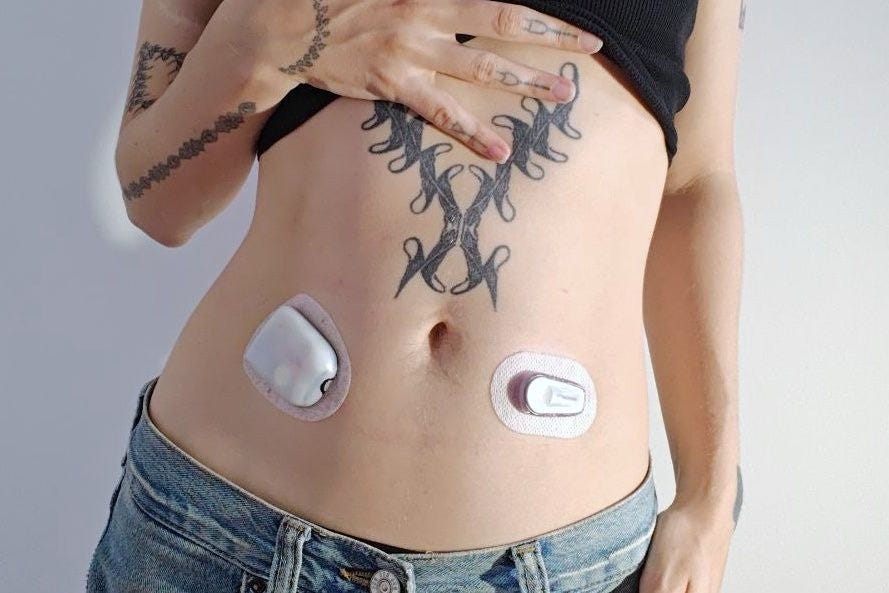
*Omnipod Dash and Dexcom G6*
One big thing I did in 2025 was finally receive a huge upgrade to my cyborg parts. This is both the fulfillment of a years-long quest, first begun on Christmas 2021, when I found out I was diabetic–and likely still not my final form. Medical tech is always evolving. The quest had many stages: From a 100+ page application to German health insurance where I had to prove I was a “real artist” in order to qualify, through 4 different Drs before I found one willing to help, and finally a 10 day long onboarding session in a Bavarian hospital this July.
I’m now using a combination of official medical hardware and open source software as an artificial pancreas. It’s still a fair bit of daily labour, but it is a lot more responsive and sensitive than the manual insulin injections I was using before. Like any open source software project, these apps come with many pitfalls: terrible documentation, complicated and unclear interfaces, github issues full of years-long unresolved squabbles. But using open source apps for insulin delivery gives me the maximum amount of freedom and agency to choose what hardware I want and how I want it to work. Diabetic tech is full of paternalistic choices that treat the patient like a child: tethered to punitive and unsilencable alarms, extremely conservative blood sugar management targets, very few options (I wrote about this from a generalizable protocols perspective last year.) To be fair, many T1 diabetic people are children–but I am not.
Like any good infrastructure, we don’t think about our organs when they’re working properly. But in my case, one of them, a critical one, stopped working. The infrastructure I must use now is clunky at best. It leaves bruises, and I’m a bit allergic to the adhesive. But I’ve found tremendous freedom in the knowledge, even unexercised, that if I ever become too frustrated with the algorithms that run my body, I can fork them. Read the code, file an issue, fix it myself, or find someone who will.
This is not possible for everyone with diabetes for a number of reasons, nor is it possible for every illness. But when it is, it unlocks something interesting: there is a foundational American narrative of “freedom”: it is about the individual, it is about sovereignty, it is vaguely (suspiciously) right wing. But the active online diabetic communities I’m part of make it impossible to ignore that community, conviviality, is not the enemy of freedom. Nor is agency. Nor is privacy. Like so many supposed deadlocks of polarization, they are revealed as illusions when one moves laterally. Becoming more free does not and has not made me more alone. If anything, the opposite. The forums where people share their configurations, troubleshoot each other’s setups, debate various approaches–these are clearly acts of genuine care, often for strangers.
There’s a position encoded here–an orientation, an embedding–towards agency and conviviality. It is one I recognize across my work and the projects I have been drawn to: community currencies, universal basic income, decentralized decision-making, protocol research, education outside of the academy, etc. Even in terms of my daily devices, I’m writing this to you here from Linux on the desktop, my default operating system for more than 10 years now. If I’m being honest, I’m not sure this orientation has served me well in all of these projects, but it can be traced through them anyway and is worth being interrogated. In the case of my cyborg extensions, there is no doubt in my mind that those sharing this alignment have created, objectively, the best diabetic management tools in the world today.
It’s very ironic that I, of all people, ended up with a chronic illness that involves such an intimate relationship with software, after spending so many years writing it for a living and also making it a major subject of my art practice. All the fantasies that involve unplugging have closed off for me: I’m in for life now. The circuit board is glued to my body. The sensor is under my skin. I don’t wanna hear about what it’s like to be a machine from anyone who’s never had a software update brick one of their organs. You think you’re “inhuman” because you scroll tiktok? Go home.
The best articulation I’ve found of the uncomfortable surface between those for whom technology is by necessity a bonafide part of their body (disabled people) and the fetishization of the cyborg by those for whom it is not comes in Jillian Weise’s essay, Common Cyborg. The essay calls out the many tech enthusiasts, tech companies, and even theorists of the cyborg like Haraway, for their omission of the most obviously “cyborg”–machine-human hybrid–forms of embodiment present in the world today. Weise begins the essay with empathy for fledgling machine intelligence itself, commenting on a text where a human writing scrutinizes an early AI:
“The human writer concludes that the text composed by the artificial intelligence ’lacks meaning’. But whose meaning? Who says what means? My heart goes out to the artificial intelligence. I believe she/he/they/it has written one of the most beautiful sentences I’ve read in the Economist. ‘A single organ is a large amount of energy, which is particularly intense.’”
Seems relatable. It is indeed only a single organ that has been the cause of all my problems, and it is indeed a large amount of energy.
And though Donna Haraway’s commentary on the cyborg has limits, I’m still willing to keep its insights. She wrote, “The cyborg would not recognize the Garden of Eden; it is not made of mud and cannot dream of returning to dust.” For me and many other cyborgs, something pastoral is closed–and with it the dark twin of the pastoral, the survivalist. I no longer have any fantasies of outliving an advanced technological civilization. I think a lot about what kind of global supply chains and energy regimes I am complicit with, or vulnerable towards. Which desires does that allow? Which futures? My Overton window of acceptable economic outcomes is now only ones that I believe could reliably produce small circuit boards, sterile subcutaneous sensors, and regular delivery of medication that is not stable at room temperature.
From these comments, I can add to the alignment I articulated earlier (agency and conviviality) a further dimension: one towards technology. Some technologies have undesirable consequences and other technologies keep me alive every day. The solution to specific problems caused by technology is not (maybe never, at least not to me) a turn away from technology on the whole. I will not be going analog. I will not be getting a dumb phone. I will not be fetishizing the hardships of the past (some of which are still the hardships of the present, in many places) from a comfortable future where they have become decorative.
And I would add also, finally and tentatively, a rethinking of personhood. These days it looks as though we might finally get new answers to old questions, like how the mind arises from the body and perhaps not if, but maybe what kind, of fallacy Cartesian dualism is. There are so many examples where policing the boundaries of “intelligence” and personhood have been violent acts, notably towards disabled people and people of colour. What will happen instead, as we expand it further, outside the human, into the animal and machinic? How can what we think of as “an individual” be ontologically renegotiated?
I’m choosing this post to introduce this substack because it is about many of the things I would like to deal with more thoroughly here: infrastructure, optimization, the permeable skin of the self (physical and otherwise), the ways it is entered by technology, praxis, the mind, software, how it could be otherwise. But for now, I am writing to you here still from a body. This body, my body. One I would certainly trade in for one that worked better, if it were possible. My great betrayer, my only home.